Showing posts with label science. Show all posts

Thursday, February 7, 2013

2012 Nonfiction Round-Up (Part One)

In which I briefly review several titles that I read last year but never got around to reviewing in depth. I totally blame this oversight on Game of Thrones.


 Miles To Go For Freedom: Segregation and Civil Rights in the Jim Crow Years by Linda Barrett Osborne

I looked at many books on civil rights last year, and this one stuck out for me because of its handsome design and wealth of photographs and illustrations. The book was published in association with the Library of Congress, and the pages of this book are saturated with of its treasures. Osborne clearly depicts how the Supreme Court ruling in Plessy Vs Ferguson allowed for segregation and the devastating effects on Americans' lives that resulted. The sources in the back led me to this great website: http://www.visionaryproject.com/. This book was named a Booklist Editor Choice for Youth.


Moonbird: A Year on the Wind with the Great Survivor B95 by Phillip Hoose

B95 is the hero of the story, a nearly 20-year-old rufa red knot who thrives in a harsh world. He's nicknamed Moonbird because he's flown at least as far as the moon, and most likely further. As a long-time survivor among a species that seems destined for extinction, it's hard not to root for him. The design of the book is very similar to the wonderful "Scientist in the Field" series, and the abundant maps and color photographs make it easy to follow along with the birds as they migrate over 9000 miles from the southern tip of Argentina to the Arctic Circle. My favorite picture is the blimpish red knot on page 31, who's fattened up to prepare for the journey. Moonbird was named a YALSA Excellence in Nonfiction and Sibert Medal honor book, and was named an Outstanding Science Trade Books for Students K–12 by the National Science Teachers Association.


Black Gold: The Story of Oil In Our Lives by Albert Marrin

This slim volume offers more breadth than depth in telling the story of oil - including its science, history and politics - from its making to our current struggle to find alternatives for it. Marrin presents thought-provoking and informative text that is aided by many helpful illustrations and diagrams. It was named an Outstanding Science Trade Books for Students K–12 by the National Science Teachers Association.
 

Superman Vs the Ku Klux Klan: The True Story of How the Iconic Superhero Battled the Men of Hate by Rick Bowers

Well-researched, fascinating parallel stories of the history of the Klan and Superman collide in 1949, when the writers of the popular Superman radio show decide to tackle hate groups. Created by a couple of Jewish kids from Ohio, Superman stood for the underdog and sought justice from the very beginning, but it wasn't until after World War II that social issues became a main focus of his adventures. The staff of the Superman radio were aided by the work of "Klan busters" like Stetson Kennedy, a Florida native who infiltrated the organization with the goal of exposing its secrets and bringing it down.


Titanic: Voices from the Disaster by Deborah Hopkinson 

Hopkinson follows several passengers and crew of the ship as they go about their daily routines. Once the boat hits the iceberg and begins to sink, the narrative transitions into a riveting struggle for survival. I was most captivated by the accounts of the men who survived by clinging to an overturned lifeboat. Their stories provided the most suspense, as they were engaged in a life or death struggle where I didn't already know the outcome. Though both the text and illustrations were enlightening, I wish that the book included a diagram of the ship that labeled the decks and locations of all the lifeboats. This book was named a Sibert and YALSA Excellence in Nonfiction honor book.

Next week, I will post brief reviews of We've Got A Job, Steve Jobs, October Mourning, My Friend Dahmer and Bomb.

Tuesday, December 18, 2012

Invincible Microbe

Invincible Microbe: Tuberculosis and the Never-Ending Search for a Cure
by Jim Murphy and Alison Blank
149 pages
Clarion Books

Publisher's Description:

For centuries tuberculosis in many forms was treated with everything from poultices and potions to the king's touch. The microorganism that causes the disease was eventually identified, more effective treatments were developed, and the cure for TB was thought to be within reach. But the TB germ simply will not die; drug-resistant varieties continue to plague and panic the human race. The "biography" of this deadly germ, an account of the diagnosis, treatment, and "cure" of the disease over time, and the social history of an illness that could strike anywhere but was most prevalent among the poor are woven together and supported by 70-plus archival prints and photographs.

My Comments:

Murphy and Blank tackle TB from three perspectives, presenting a biography of this evolving microorganism, an account of how the illness came to be treated and cured, and finally a social history of the disease.

I was fascinated by the many photographs, including one of a 500,000 year old fossilized skull of a homo erectus that contained scars caused by TB bacterium. The layout is one of the strong points of this book. That skull photograph appears on a two-page spread along with an image of m. tuberculous bacteria up close and sneeze droplets. The images and accompanying text concisely tell the story of how tuberculosis works.

Later sections detail how the Industrial Revolution contributed to TB's spread, crazy treatments that have been attempted over the years (including sewing ping pong balls inside patients' chests), scientific research by Robert Koch that led to legitimate treatments, TB in popular culture (the Bronte sisters made it glamorous), and the sanitorium movement that became popular in the United States for a time.

The book ends with a discussion of TB's growing resistance to drug treatment and current TB hotspots around the globe, where unsanitary prison conditions and outdated treatments fuel the disease. For now, we can only contain the disease by focusing on early detection and developing new drugs.

This was a fast, surprisingly entertaining read. Back matter includes a bibliography, source notes and index.

Monday, October 22, 2012

Temple Grandin

Temple Grandin: How the Girl Who Loved Cows Embraced Autism and Changed the World
by Sy Montgomery
148 pages

Houghton Mifflin


Publisher's description: 

When Temple Grandin was born, her parents knew that she was different. Years later she was diagnosed with autism. While Temple’s doctor recommended a hospital, her mother believed in her. Temple went to school instead. Today, Dr. Temple Grandin is a scientist and professor of animal science at Colorado State University. Her world-changing career revolutionized the livestock industry. As an advocate for autism, Temple uses her experience as an example of the unique contributions that autistic people can make. This compelling biography complete with Temple’s personal photos takes us inside her extraordinary mind and opens the door to a broader understanding of autism.

My comments:

I've enjoyed several of Montgomery's books about animals (especially Kakapo Rescue and The Good Good Pig) so I figured she would be a perfect fit to write about Temple Grandin's passion for animal welfare. I was not disappointed. Her writing is always engaging and warm, and I was immediately sucked in to her account of Grandin's life. I was especially struck with her description of how Grandin felt, as an autistic child, to be constantly overwhelmed by sensory data.

Montgomery makes clear to readers that people with austism make up a wide spectrum, from geeky but gifted kids to people who barely talk. The boarding school that Grandin attended in New Hampshire after being expelled from high school is compared to Hogwarts. Before Harry Potter went to Hogwarts, he was confused by his strange abilities and felt out of place. Once he went to a school where he could learn to harness his abilities, he was better able to cope in the larger world.

The book design is very eye-catching, and it's full of color photographs and Grandin's own diagrams. I found the section about the dip vat she designed to be very enlightening.  Montgomery tells the story of how Grandin was hired to design a new dip vat for delousing cows that wouldn't frighten them and result in deaths like the old vats did. Her keen eye for detail and ability to think in pictures, benefits of her autism, allowed her to see exactly what about the dip vat frightened the cows. The accompanying images were very helpful in explaining how the dip vat works

There are several cool extras included,as well,inclduing a page of facts about factory farming and a section of advice for kids with autism from Temple Grandin herself. Grandin also wrote the forward, and seems to have cooperated with Montgomery throughout the book's creation, posing for pictures and allowing photographs to be taken of her home.

A thorough bibliography and index are appended.


Wednesday, October 13, 2010

Kakapo Rescue

Kakapo Rescue: Saving the World's Strangest Parrot
by Sy Montgomery (photographs by Nic Bishop)

80 pages
published by Houghton Mifflin


Publisher's description:
On remote Codfish Island off the southern coast of New Zealand live the last ninety-one kakapo parrots on earth. These trusting, flightless, and beautiful birds—the largest and most unusual parrots on earth—have suffered devastating population loss. Now, on an island refuge with the last of the species, New Zealand’s National Kakapo Recovery Team is working to restore the kakapo population. With the help of fourteen humans who share a single hut and a passion for saving these odd ground-dwelling birds, the kakapo are making a comeback in New Zealand. Follow intrepid animal lovers Sy Montgomery and Nic Bishop on a ten-day excursion to witness the exciting events in the life of the kakapo.


My comments:
This book pretty much has it all - lovable characters, humor, drama, danger, romance, tragedy and a hopeful ending. The Kakapo are introduced by name; all are adorable and full of personality. The scientists who appear in the book take a back seat to the birds, and I think this is a wise choice. Lisa is an attentive mother and Richard Henry is a distinguished senior statesman. One male, Sirocco, was raised by humans and thinks that he's human, too. His efforts to find a mate add humor, romance and danger (one ranger stubs a toe while running from Sirocco's unwanted affection) all at once.
Montgomery and Bishop literally had to wait for years to create this book, so that they could visit the birds at a time when they were breeding. When they arrive at Codfish Island, there are 88 birds. Births and deaths occur during their 10-day research mission (visitors are only allowed on to the island for 10 days at a time). Each hatching egg is attended with great anxiety and celebration, and each death is a crushing blow.

Bishop provides many lush green photographs of the parrots and their surroundings, but doesn't leave the humans out. We see them weighing and feeding chicks and tracking the birds through the dense forests. We even see the author in one photograph, during her magical encounter with a curious Kakapo named Sinbad. There are also photographs of other native birds and even a very cool shot of a bat in flight.

The writing has an engaging journalistic sensibility and (except for sections on the history of the birds and the other Richard Henry, a famed conservationist) is told in the first-person and present tense. Most of the research for the book was conducted on-site, so there are no notes. A few helpful books are listed in the back; four recent titles and one historical book from 1888. The website and mailing address for the Kakapo Recovery Programme are also included.
I think this book benefits from having the right subject, right author, and right photographer all come together to create something very special.

Thursday, October 7, 2010

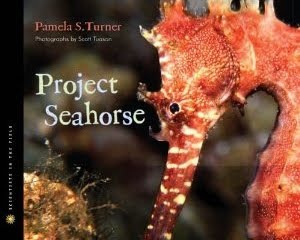
Project Seahorse

Project Seahorse
by Pamela S. Turner

56 pages
published by Houghton Mifflin

Publisher's description:
Seahorses, some of the ocean’s most charming fish, are in trouble. In the past twenty years their populations has declined. They are threatened by overfishing, pollution and climate change. In Handumon in the Philippines, villagers and conservationists have joined to protect the seahorse and the coral reefs where they live. Amanda Vincent and Heather Koldewey, founders of Project Seahorse, work with Filipino colleagues and local fishers like “Digoy” Paden to protect seahorses and the livelihood of local fishing families. Through their efforts the Handumon Marine Protected Area is now a model “underwater park” where marine life is safe from fishing.

My comments:
I really liked Turner's last book for the Scientists in the Field series, The Frog Scientist, and fell in love with the leafy seadragons at the Shedd Aquarium more than 10 years ago; so I was excited to read this one.

Turner does a good job of explaining that, despite their unusual appearance, seahorses are fish. She a really good job of explaining how male seahorses give birth and how this unusual reproductive strategy came to be. What she does a fantastic job of is explaining the integral role that seahorses play in life on earth, and why they are worth conserving.

She balances coverage of the seahorses and their underwater environment with the local people who feed their families and make a living through fishing. The book shows that Project Seahorse is making an impact because of cooperation between scientists and locals.

The photographs are fantastic and the book design is attractive. However, I couldn't help being distracted by the white borders, tilted angles and drop shadows, which reminded me of iPhoto. The impressive index includes page numbers for all the photographs and captions, and you can look up each seahorse species that appears in the book.

Other materials include a guide on how to help seahorses (courtesy of Project Seahorse), a glossary, and a list of resources that includes, videos, websites and books. I was disappointed to see that the only books listed are other titles from the same series about the ocean. Where are more books about seahorses? I would have also liked to see a list of aquariums (like Shedd) where you can see seahorses up close.

My impression is that this is yet another very strong title in the Scientists in the Field series, but not the best.

Your comments?

Wednesday, October 6, 2010

If Stones Could Speak

If Stones Could Speak: Unlocking the Screts of Stonehenge by Marc Aronson
64 pages
published by National Geographic


Publisher's description:
What are the secrets of the ancient stones? Were they a burial site, an ancient calendar, a sports stadium, a place of Druid worship... or even a site of sacrifice? World-renowned archaeologist Mike Parker-Pearson recently began a new quest to excavate the wider area around Stonehenge to answer these and many other questions. National Geographic helped sponsor their mission, and now Mike takes our young readers behind the scenes to experience this groundbreaking story first-hand, through the eyes of the experts.
Within the past three years, Mike and his team have revolutionized our understanding of Stonehenge by exploring the surrounding landscape for clues about the stones. The results have been breathtaking: the team recently unearthed the largest Neolithic village ever found in England. If Stones Could Speak brings young readers the inspirational story of the incredible discoveries now taking place at this World Historical Site. The informative and drama-driven text includes tales of dead bodies, cremations, feasting, and ancient rituals, as well as science like carbon dating. The images include some of those featured in National Geographic's cover story on the discoveries, for which the stones were "painted in light" at night with awe-inspiring results.
The expert text, stunning photography, and explanatory maps and illustrations will all help young readers see this ancient monument in totally new ways, and no doubt inspire future generations of archaeological explorers.


My comments:
I found this to be a fascinating book in the vein of Written in Bone, one of my favorites from last year. It combines history, mystery, and the thrill of seeing scientists form and test a theory that leads to exciting discoveries. Concepts important to the archaeologists' work, like carbon-14 dating and strontium analysis, are explained in a clear manner. So is one major problem the scientists in the book encountered when studying Stonehenge, by way of the hypothetical discovery of basketball court 4,000 years from now (p. 27). If most experts agree that the court was used for religious rituals and one suggests that it was used to play a game, who would be believed?

I really liked the middle chapters, (four, five and six) for the story they tell. Mike, an archaeologist from England, brings Ramilisonina, an archaeologist from Madagascar, to Stonehenge to look at the stones with "fresh eyes." In Madagascar, people live in wooden homes and build monuments to the dead out of stone, and this is what Ramilisonina saw: a monument to the builders' ancestors. In chapter seven, their theory bears fruit when they discover the remains of an ancient village.

There are an abundance of beautiful color photographs, as well as an illustrated map of the stone circle and surrounding archaeological sites to give readers a sense of the area being studied. Despite these images, I had a hard time grasping the connections between all the different sites (Southern Circle, the Long Barrow, the Cursus, etc.). I understand what each one was, but not how they are bound together. Maybe this is because there is so much that is yet to be learned about each one of them.

The materials at the end include an annotated factfinder index, a list of archeologists and their theories, a chronology of the riverside project, and a list of its members. Unfortunately, when I wanted to go back and read the basketball court analogy again, I couldn't find it using the index. There's also a timeline for Stonehenge, accompanied by an explanation that this timeline is ever-changing becasue of continued scientific investigations. I was disappointed that the timeline didn't help me to better understand the connections between the different sites. On the very last page is a list of books for further reading (divided into categories for kids and adults) and a few online resources including National Geographic, where you will find more stunning photographs.

Your comments?

Monday, October 4, 2010

This Is Rocket Science

This Is Rocket Science: True Stories of the Risk-Taking Scientists Who Figure Out Ways to Explore Beyond Earth by Gloria Skurzynski
80 pages
published by National Geographic


Publisher's comments:
From the award-winning author of Are We Alone? comes a title to propel young imaginations far into space. This Is Rocket Science explores the past, present, and future of space travel. The compelling text—vetted by NASA scientists—is a combination of history, science, human drama, and future challenges. Readers learn how fireworks in ancient China developed into the fire arrows used by Genghis Khan; we meet Sir Isaac Newton, Jules Verne, H.G. Wells, and learn how their imaginations shaped rocketry. We revisit the era of Sputnik, the satellite that launched a superpower space race, ending with moonwalks and a rendezvous in space. Finally we look forward to the future challenges of Mars and beyond. We also get a sneak peek at new technologies like space elevators, solar sails, ramjets, and more.


My comments:
The cover of this book is what really attracted me to it. The cover image and title both scream, "Pick me up, there's cool stuff inside!" Inside is a nice balance of the history of rocket science (beginning with alchemists in ancient China) with its future possibilities (new technologies like nano tubes and solar sails could make missions to Mars and beyond a reality and not just fiction).
There are also lots of color photographs and illustrations, pulled quotes and informative captions.

I found one editorial error, at the bottom of page 21. A thought is cut off mid-sentence, and the next page begins with a new paragraph. The meaning of the sentence fragment can be worked out by rearranging the words and the next paragraph is on the same topic, so I think this was more of a forgot-to-rewrite-the-sentence error than accidentally-deleted-two-pages-of-text error.

Skurzynski successfully blends science and history, explaining Newton's three laws of motion and how they apply to rockets, the stories of three men who would become known as the fathers of modern rocketry, the space race between the US and Soviet Union, and the competition between chemical and nuclear propulsion for funding in the United States.

Where rocket science takes us next (and how) is still uncertain. SpaceX, a private company launched by PayPal entrepreneur Elon Musk, gets attention for its potential role as taxi service to the International Space Station: after a few more missions, our shuttles will be retired. The dynamics of at least one question raised in the book (whether we would be heading once again to the moon or lighting out instead for Mars) have been altered recently by the approval of Bill S. 3729, which provides a total of a total of $58 billion to NASA through 2013.

The information in this book will eventually become dated, but for now, it sheds light on ideas that are at the cutting edge. There's been a lot of talk about a "new direction" for NASA, and Skurzynski highlights some of the possibilities.

The final pages include a glossary and lists of other interesting books and websites, all in tiny print. Quote sources and illustration credits are squeezed, also in tiny print, on to a single page. Looking at it hurts my eyes. The single-page index is in slightly larger print that is much easier to look at. Would it have been so hard to add a couple more pages, so at the glossary and bibliography were easier to use?

Your comments?

Friday, July 2, 2010

The Hive Detectives

The Hive Detectives: Chronicle of a Honey Bee Catastrophe
by Loree Griffin Burns
80 pages
published by Houghton Mifflin Harcourt


Publisher's Comments:

Without honey bees the world would be a different place. There would be no honey, no beeswax for candles, and, worst of all, barely a fruit, nut, or vegetable to eat. So imagine beekeeper Dave Hackenburg's horror when he discovered twenty million of his charges had vanished. Those missing bees became the first casualties of a mysterious scourge that continues to plague honey bee populations today. In The Hive Detectives, Loree Griffin Burns profiles bee wranglers and bee scientists who have been working to understand colony collapse disorder, or CCD. In this dramatic and enlightening story, readers explore the lives of the fuzzy, buzzy insects and learn what might happen to us if they were gone.


My comments:

This is another solid entry in the Scientists in the Field series. Burns provides a very interesting look at honeybees, the mysterious affliction (Colony Collapse Disorder) that have decimated their populations since 2006, and the scientists who study them. The pages are full of colorful high-quality photographs that show off the bees and the different colors of honey that they produce, as well as lots of facts about bees, apiarists (another name for beekeepers) and the scientists, of course.

I like that the various theories of what is happening to the bees are presented, as well as the evidence the scientists find that either rule them out or mark them as possible culprits. It's made clear that we don't know for sure what is happening to the bees yet, and that further research is necessary.

At the end there is a helpful glossary of bee-related terms, the cutely named "Appendix Bee," and a nice list of resources (including books, documentaries and websites) for further study.

This book didn't grab me as much as another title in the same series, The Frog Scientist. I think this is partially because The Hive Detectives highlights several scientists instead of focusing on one. There simply isn't time or space for Burns to get very personal with her subjects.

Your Comments?